
Blueberries are flowering plants in the genus Vaccinium, sect. Cyanococcus. The species are native only to North America. They are shrubs varying in size from 10 cm tall to 4 m tall; the smaller species are known as “lowbush blueberries” (synonymous with “wild”), and the larger species as “highbush blueberries”. The leaves can be either deciduous or evergreen, ovate to lanceolate, and from 1–8 cm long and 0.5–3.5 cm broad. The flowers are bell-shaped, white, pale pink or red, sometimes tinged greenish. All species whose English common names include “blueberry” are currently classified in section Cyanococcus of the genus Vaccinium. Several other plants of the genus Vaccinium also produce blue berries which are sometimes confused with blueberries, mainly the predominantly European bilberry (Vaccinium myrtillus), which in many languages has a name that means “blueberry” in English. See the Identification section for more information.
However the real star of the show here is not the Blueberry but the muffin. That’s right! The muffin an american evolution to a british classic. The muffins in England are leveled by yeast the unicellular creatures that digest the sugars to CO2. However in the America the early settlers did not had the time or the luxury of yeast and therefore they got the leveling from chemical methods. And Although to many muffins and cup cakes are no different there is a fundamental difference, in cup cakes the butter is beaten with the sugar and that results in nucleation, the poking of tiny little holes in the butter that when the CO2 from the chemical levelers will further inflate. In muffins the leveling results directly from the chemical levelers, that requires a even distribution in the batter. However, everyone who ever blow a bubble will tell you that to hardest part in doing so is the initial blow. So the bubbles will be harder to be created and all the pressure will go to the initial bubble formation resulting in a finer texture and significantly more dense bread. So Muffins are muffins and cup cakes are cup cakes. No confusion ok?
Here we will start with the basic muffin recipe that you can use as the base for all muffins.
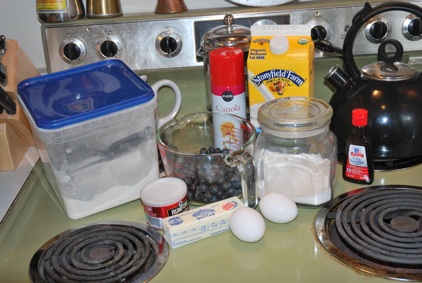
We will need:
Dry team:
- •1 and 1/4
cup of flour
- •2 tsp of
baking soda
- •a pinch of
salt
- •2 eggs:
- •1 cup of
sugar
- •4 tbsp
butter
- •1/2 cup of
sugar
- •1 tsp
Vanilla extract
- •1/2 cup of
milk
- •1 cup of
blueberries (1 used 1 1/2 which was a lot)
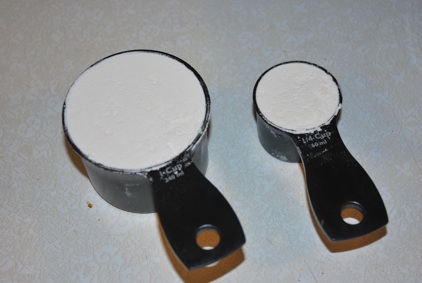
Measure the
flour precisely. That will be better weighted
but I do o have a scale so that will do.
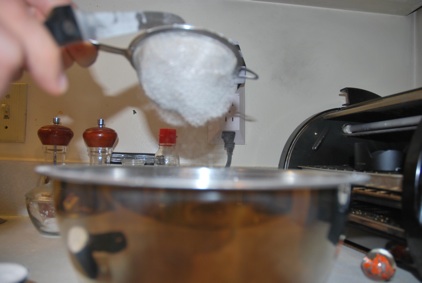
Sift them in
your work ball. You can use a sifter but the
one I had I used twice I throw it out because
it is impossible to clean these things. Anyway,
here I have a strainer which I tap with a
knife. Takes time but you can clean it.
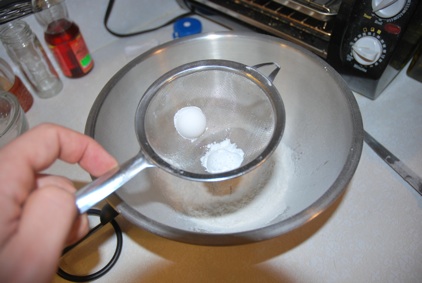
Repeat with
the baking powder.
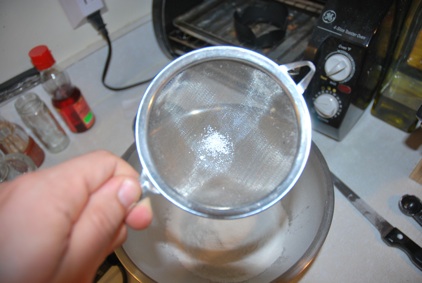
These are what
you sifting for. Ok?
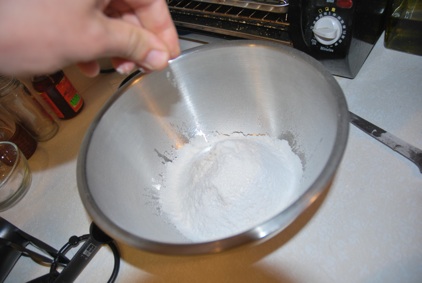
Add the pinch
of salt.
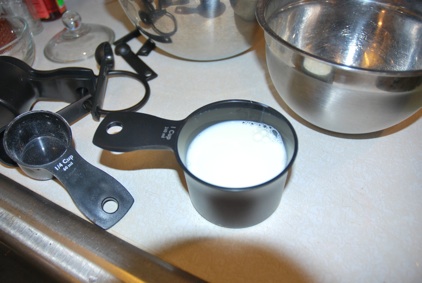
Take the half
cup of milk.
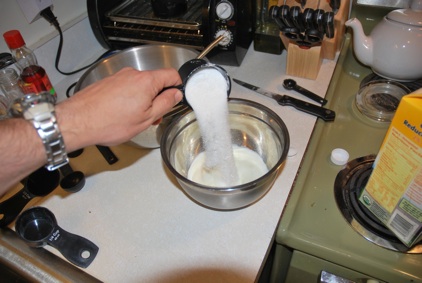
Mix it with
half cup of sugar.
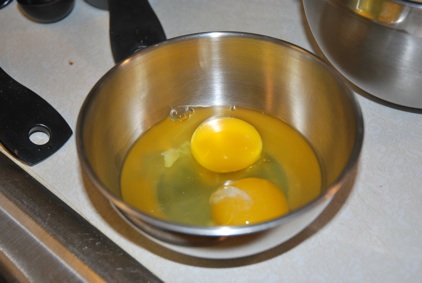
And crack open
the two eggs in a bowl. You can crack the in
the liquid batter immediately but I like this
way since you can avoid any spoiled eggs and
fish out possible shells.
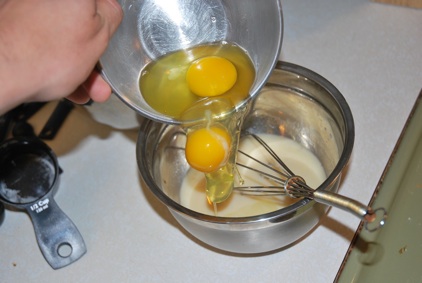
Add them to
the butter and mix them.
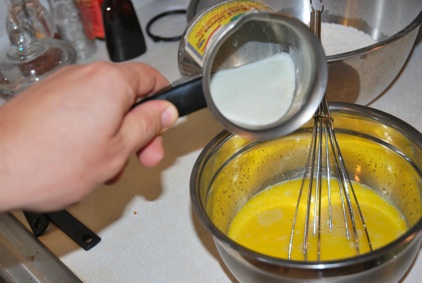
Add the melted
butter.
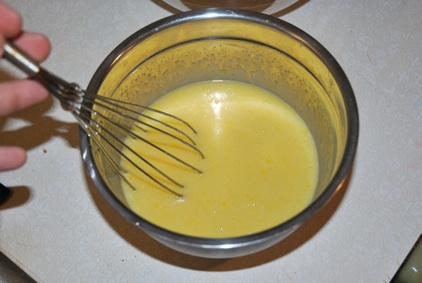
And mix again.
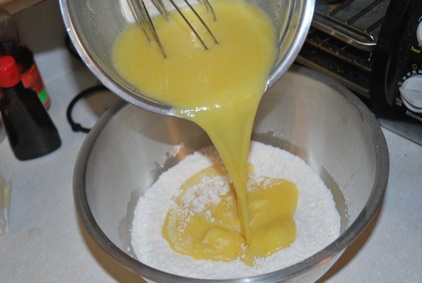
Add the liquid
team over the dry team and mix with a spatula
as less times as possible. Over-mixing will
result in gluten, the springy protein substance
the gives bread and pizza their chewing
pleasure.
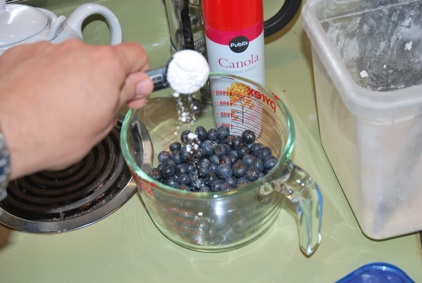
Add a teaspoon
of flour on the fresh blueberries to dust them.
That will make the batter get a hold on them.
Like velcro or something.
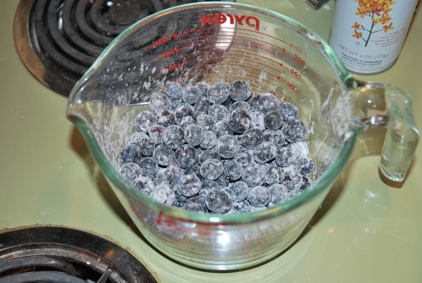
Just like
this.
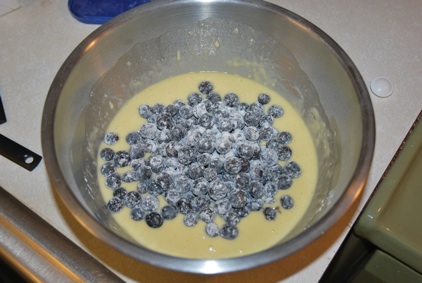
Add them in
the mix and slowly stir them in.
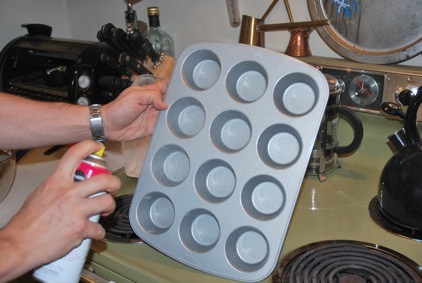
Lube your
muffin tins…
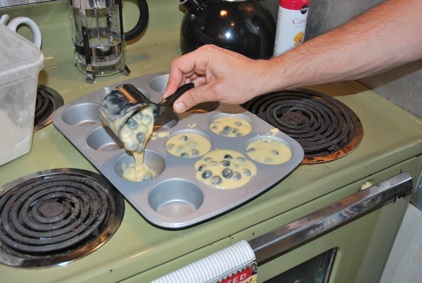
And dose the
batter. 2/3 from the top, or till it is evenly
spread in the 12 tins.
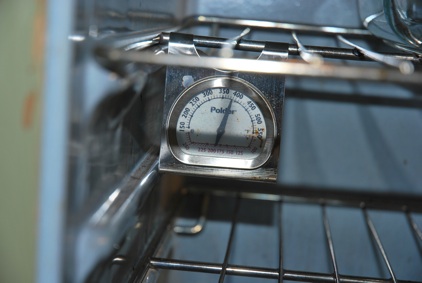
Set your oven
at 375 F and bake till they are GBD. Golden
Brown and Delicious. You need an oven
thermometer. You need to make sure that you
have the right temperature before you add the
muffins in.
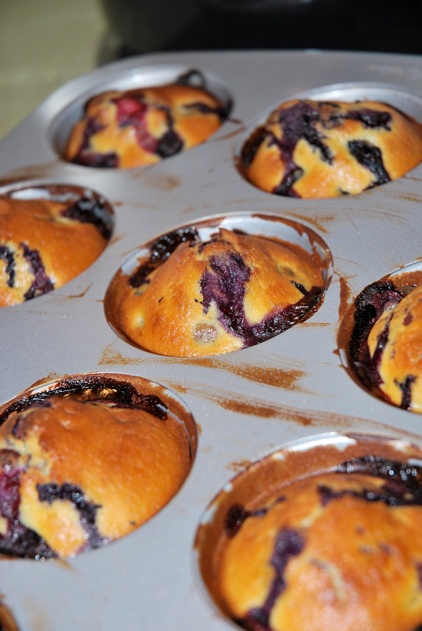
This is what
the GBD looks like. I over did it with the
blueberries and some exploded, but there were
still delicious never the less.

Once you
remove them put them on a rack to cool them.
This will make a crunchy bottom.
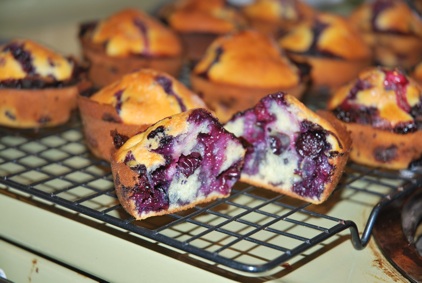
And here is
the interior. MMmmm yummy…
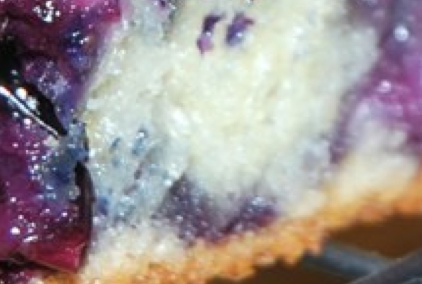
And here you can see the microstructure. Small
even bubbles.
Enjoy…
Blowing a bubble requires more pressure the smaller the radius is. It is also mathematically proven with the Laplace equation.