
Thanksgiving has become one of my favorite holidays. Actually, I would go as far as saying that it is probably my favorite American holiday. Not probably, just my favorite American Holiday. Actually my favorite holiday. Not the fourth of July, not Labor day, not Memorial day. Thanksgiving. And anyone who knows me might immediately assume that this has something to do with the food. After all, we are talking about a holiday built around an enormous meal, with turkey, stuffing, mashed potatoes, gravy, cranberry sauce, and more side dishes than anyone could reasonably need. And yes, I absolutely love the food. I love preparing it, I love eating it, and I particularly love the fact that Thanksgiving gives me a perfectly legitimate excuse to spend an unreasonable amount of time in the kitchen. But as much as I enjoy the culinary side of Thanksgiving, that is not really why this holiday means so much to me. The reason is something much more personal, something that goes back to my very first years in America and to a feeling that I will always cherish.
I understand why so many people love Thanksgiving. It is about family, friends, gathering around the table, and being thankful for everything we have. It is about sharing a meal with the people we love, appreciating what life has given us, and enjoying that wonderful feeling of warmth and togetherness. The traditional story of Thanksgiving is also connected to gratitude, to the Pilgrims and the Native Americans who helped the newcomers survive in an unfamiliar continent, although the actual history of their relationship is considerably more complicated than the version we often hear. But for me, as an immigrant, Thanksgiving carries an additional meaning. It is not simply a celebration of gratitude or an opportunity to enjoy an elaborate meal. Thanksgiving is the holiday that made America feel like home to me.
My First Thanksgiving in America
I arrived in the United States on August 9, 2001. That was the first time I ever set foot in this country, and it is hard to believe that more than twenty-five years have passed since then. I came to Gainesville, Florida, to pursue my graduate studies at the University of Florida, and like many international students, I found myself adjusting to a completely new environment, a different culture, and a rather demanding academic schedule. My days were filled with classes, laboratory work, studying, and trying to figure out how everything worked in this new country. Thanksgiving was not exactly at the top of my list of priorities.
Of course, I knew about Thanksgiving before coming to America. Growing up outside the United States, I had learned quite a bit about American culture through movies and television. And one television show, in particular, had played an important role in my understanding of Thanksgiving: Friends. Yes, Friends. Almost every season had a Thanksgiving episode, and by the time I arrived in America, I had practically memorized every episode that had aired up to that point. The show would continue for another three years, but I had already watched the earlier seasons several times. So I knew about Thanksgiving. I knew about the turkey, the family gatherings, the traditions, and, thanks to Friends, all the hilarious things that could go wrong during a Thanksgiving dinner. In a strange way, the show had introduced me to the holiday long before I ever experienced it myself.
But knowing about a holiday and feeling that it belongs to you are two very different things. Thanksgiving was something Americans celebrated. It was part of their culture and their traditions, not mine. I had never celebrated it growing up in Greece, and I had no particular emotional attachment to it. So when my first Thanksgiving arrived in November 2001, I treated it as exactly what it was to me at the time: two days off. Two wonderful days without having to go to school, without having to go to the laboratory, and without having to worry quite as much about my already packed class schedule. As a graduate student, I certainly appreciated the break.
I remember that Thanksgiving morning surprisingly well. I woke up, read some books, and spent some time on the internet. Now, for the younger readers who might not remember those days, the internet was a completely different experience back then. We had dial-up connections. You had to connect your computer through a telephone line, dial into a server, and wait for the connection to establish itself. It was slow, it was noisy, and it was nothing like the always-connected world we live in today. After spending some time reading and browsing the internet, I decided to get dressed and go out.
And by getting dressed, I mean putting on a pair of shorts and a Hawaiian shirt. Yes, a Hawaiian shirt. On Thanksgiving. Now, before anyone starts questioning my fashion choices, remember that I was living in Florida. Granted, Florida is not Hawaii, but those were pretty much the clothes I had at the time. Why that was the case is an entirely different story, perhaps one for another day.
Anyway, a friend of mine came over, and we decided to go out for lunch. Not to someone’s house for a traditional Thanksgiving dinner, and certainly not to a restaurant serving turkey and stuffing. We went to a Chinese buffet. It was called China Super Buffet, on 13th Street in Gainesville, Florida. I remember the place as if it were yesterday. In fact, I looked it up recently and discovered that it had closed. We had sushi, General Tso’s chicken, orange chicken, other fried chicken preparations, and all sorts of other dishes that you would expect to find at an American Chinese buffet. We went back for seconds, probably thirds, and eventually made our way to the desserts, including those colorful little portions of Jell-O that seemed to be everywhere at the time. We absolutely stuffed ourselves, and the whole thing cost about twelve dollars. Twelve dollars very well spent, I might add.
It was a wonderful meal, especially on a graduate student’s budget. I enjoyed the food, enjoyed the company, and certainly appreciated having a couple of days away from the laboratory. I was happy, I had a good time, and I had treated myself to something a little different. But that was it. There was no deeper connection to the holiday, no particular feeling of gratitude associated with the occasion, and certainly no sense that I was participating in something meaningful to American culture. Thanksgiving was simply a holiday, and I had enjoyed my day off.
The following year, in 2002, things started to change a little. Instead of going to a Chinese buffet, we went to Perkins, where they were serving a traditional Thanksgiving dinner. And this time, we had the whole experience. There was turkey, mashed potatoes, green bean casserole, stuffing on the side, and, of course, pumpkin pie for dessert. It was everything I had seen on American television, finally sitting there on a plate in front of me. And I thought it was absolutely incredible. I genuinely remember thinking that this was some of the best food I had ever eaten.
Little did I know that, by my standards today, that meal was probably mediocre at best. Nothing particularly special, just an ordinary restaurant Thanksgiving dinner. But back then, I didn’t know any better, and I loved it. Every single bite. The turkey, the stuffing, the mashed potatoes, even the green bean casserole. It was all new to me, and there was something exciting about finally tasting the foods that I had associated with this holiday for so many years. Looking back, I find it rather amusing how much my standards have changed. After years of cooking, experimenting, and preparing elaborate Thanksgiving feasts, I doubt that the same meal would impress me very much today. But at the time, it was fantastic.
And that experience stayed with me. It made me curious about Thanksgiving food, and as I started learning to cook and preparing some of these dishes myself, that curiosity only grew. I wanted to understand what made this meal so special, why Americans went to so much trouble to prepare it, and what it would be like to experience Thanksgiving in someone’s home rather than at a restaurant. I had tasted the food, but I still hadn’t really experienced the holiday. I didn’t realize it at the time, but that meal at Perkins was another small step toward something that would eventually become very important to me.
A Turkey, Alton Brown, and a New Tradition
Then, in 2003, something happened that would eventually change my relationship with Thanksgiving. I watched an episode of Good Eats with Alton Brown in which he was preparing a Thanksgiving turkey. Now, I have talked about Good Eats and Alton Brown before, and I am sure I will talk about them again. The influence that show had on me, both as someone who loves cooking and as someone who approaches food from a scientific perspective, was enormous. Alton Brown had this wonderful ability to explain not only how to prepare something, but why things worked the way they did. For someone with my scientific background and growing fascination with cooking, that approach was irresistible.
And here he was, preparing a Thanksgiving turkey. What fascinated me wasn’t simply the recipe. It was the care, attention, and thought he put into preparing that bird. He approached the turkey as something worth understanding, something that could be mastered through knowledge, technique, and a little bit of science. I was fascinated. I have since read one of his books in which he reflects on that turkey recipe, and it seems he doesn’t hold it in quite the same high regard that many of us do. But that doesn’t change what it meant to me at the time. For me, watching that episode was a revelation. Here was this enormous bird, essentially a giant chicken, and Alton Brown was explaining how to cook it in an oven. And I thought to myself, I can do that. I watched that episode again, and again, and again. I wanted to understand the process, how to prepare the turkey, how to season it, how to cook it properly, and how to turn something that seemed intimidating into something manageable.
Deborah Anderson: A Home Away From Home
There is another part of this story that I cannot leave out, because it played an enormous role in how Thanksgiving became such an important part of my life. When I was an international student at the University of Florida, there was one place where international students who didn’t have somewhere to go for Thanksgiving could always find a home. That was Deborah Anderson’s house. Deborah was, and still is, an amazing person who opened her arms, her heart, and her home to everyone without asking questions. It didn’t matter where you came from, what your background was, or why you happened to be in Gainesville. If you didn’t have somewhere to go, you were welcome. It was that simple. And for many of us, living thousands of miles away from our families, her house truly became a home away from home.
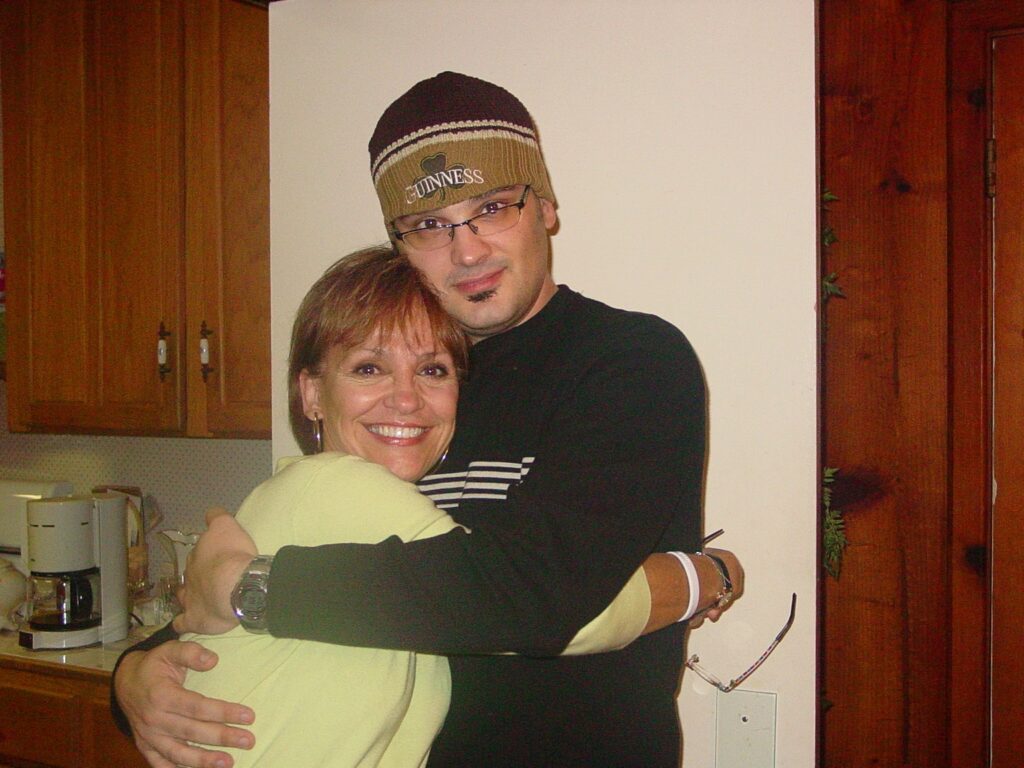
I remember going to Debra’s house for Thanksgiving in 2004 and experiencing that wonderful feeling of being welcomed into someone’s home, sitting around a table, and participating in a celebration that only a few years earlier had meant very little to me. When you are far away from your family, especially during holidays, you become much more aware of the things you are missing. You might have friends, classmates, and colleagues, but that doesn’t necessarily replace the warmth of being at home, surrounded by people who care about you. Deborah understood that. Instead of simply feeling sorry for international students who had nowhere to go, she did something about it. She opened her home and invited us in. No expectations, no questions, just an opportunity to share a meal and be part of something. And that meant more than I think she could ever imagine.
By that time, my fascination with Thanksgiving had grown considerably. I had experienced that first traditional meal at Perkins, watched Alton Brown prepare his turkey more times than I could count, and started experimenting with Thanksgiving cooking myself. But I still wanted to experience the holiday properly, in an American home, with all the food, the preparations, and the traditions that came with it. And that was one of the reasons I was so excited about going to Deborah’s house. I wanted to see Thanksgiving up close, to understand what all the excitement was about, and to experience something that until then I had mostly known through television, restaurants, and my own rather limited attempts at cooking.
What I experienced was so much bigger and better than anything I had imagined.
First of all, Debra didn’t just prepare a turkey. She prepared three turkeys. Yes, three! Two were roasted in the oven, and the third was smoked. Now, remember that just two years earlier I had been completely amazed by a fairly ordinary Thanksgiving dinner at Perkins. You can imagine what it was like for me to walk into a house where someone was preparing three entire turkeys for Thanksgiving. It was an incredible amount of food, and that was just the beginning.
Because Debra’s Thanksgiving was not simply a traditional American dinner with turkey and all the familiar side dishes. Every international student who came would bring something from their own country. It might be a dessert, a side dish, a dip, an appetizer, or something completely different. Everyone contributed whatever they wanted, often something that reminded them of home. And so, alongside the three turkeys and all the traditional Thanksgiving food, there was this incredible collection of dishes representing different countries, different cultures, and different culinary traditions.
Just imagine that for a moment. Here we were, a group of students who had come to America from all over the world, gathering in someone’s home to celebrate a holiday that most of us had never celebrated growing up. And instead of simply sitting down and eating an American Thanksgiving dinner, we were all contributing something of our own. We were bringing the foods we had grown up with, the flavors we knew, and the traditions that reminded us of our families back home. And somehow, all of those different things came together around the same Thanksgiving table.
I remember thinking about something that I had heard countless times since coming to the United States: America is a melting pot. It is one of those expressions that people use so frequently when describing this country. Different people, different nationalities, different cultures, all coming together to form something larger. I understood the concept, of course. But sitting there at Debra’s house, surrounded by people from all over the world, with three turkeys and an extraordinary assortment of international dishes on the table, I realized that I was actually experiencing it.
This was the American melting pot, right there in front of me. Not as an abstract idea, not as something I had read in a book or heard someone talk about, but as something real. Every person around that table had a different story. We had come from different countries, spoken different languages, and grown up with different traditions. Yet here we were, celebrating the same holiday, enjoying each other’s food, and sharing an experience that was distinctly American. Nobody had to give up their own culture to participate. Quite the opposite. We were encouraged to bring it with us, to share it with everyone else, and to make it part of the celebration.
And that, to me, was an extraordinary realization. I had gone to Debra’s house because I wanted to experience a traditional American Thanksgiving. I wanted to see the turkey, the side dishes, and everything else that I had been hearing about for years. But what I found was something much more meaningful. I found a celebration in which people from all over the world could come together, each bringing a little piece of their own home, and somehow create something that belonged to all of us. It was American precisely because it brought all those different people together.
I think people sometimes underestimate the importance of gestures like that. When you are an international student, especially during your first few years in a new country, you are trying to find your place. You are learning how things work, making new friends, adjusting to different customs, and trying to build some kind of life away from everything that is familiar to you. You might be surrounded by people all day at the university, but that doesn’t necessarily mean you feel at home. Having someone invite you into their house, especially for a holiday that is so closely associated with family, can make an enormous difference. Deborah didn’t just offer us Thanksgiving dinner. She offered us a place where we could feel that we belonged.
When Thanksgiving Became My Own Tradition
The following year, in 2005, I decided that I wanted to do something similar. I wanted to host Thanksgiving at my own house, especially for friends who didn’t necessarily go to Debra’s. I wanted to prepare the turkey, make the side dishes, invite everyone over, and create that same feeling of warmth and togetherness. What started as a relatively small gathering eventually became a tradition that continued for years. Well, perhaps not immediately. What had previously seemed like a distinctly American tradition, something I could only observe from the outside, suddenly became something I could participate in myself. I could cook the turkey, make the side dishes, invite friends over, and create my own Thanksgiving dinner.
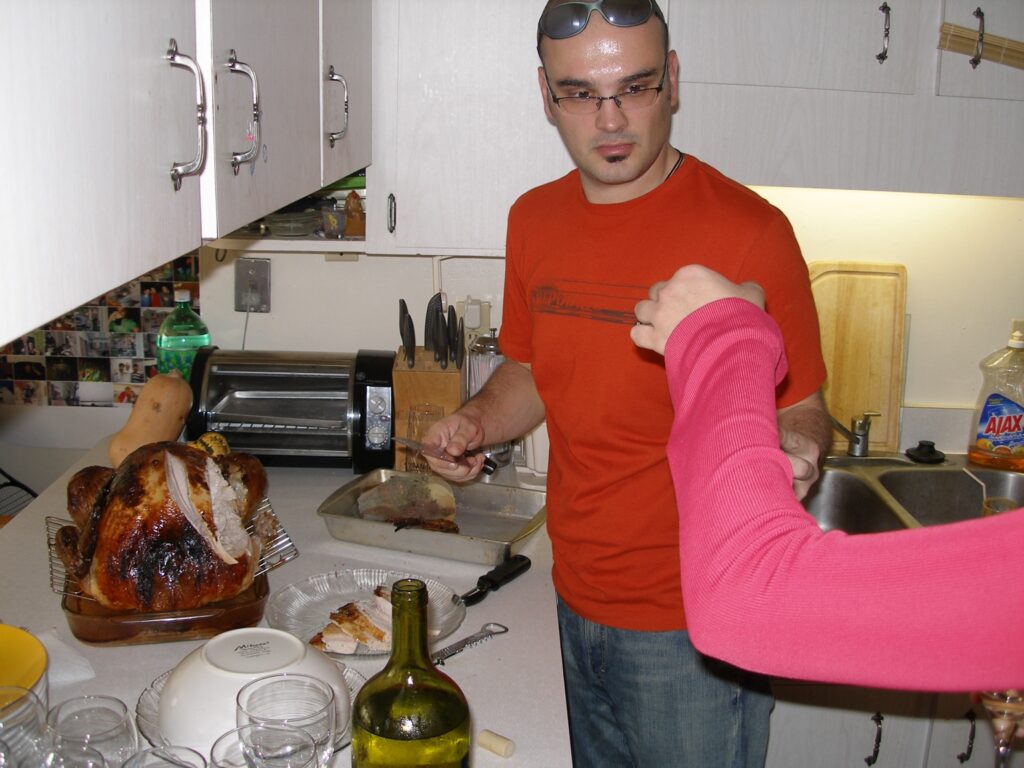
Those first attempts at putting together a Thanksgiving meal were rather simple. There was turkey, mashed potatoes, and basic stuffing. Nothing particularly elaborate, certainly nothing resembling the enormous feasts I would eventually prepare. And we were still rather selective about which American traditions we were willing to embrace. Cranberry sauce, for example, was something we initially dismissed, but I secretly liked. Homemade off course, following Alton’s recipe. We couldn’t quite understand what it was supposed to contribute to the meal. It seemed like such an American thing, something people ate simply because it was Thanksgiving, and we didn’t particularly appreciate the idea. Looking back, I find that rather funny, especially considering how much my appreciation for Thanksgiving food has changed over the years. We also had spinach pie (because we were Greeks), we had tzatziki (because we were Greek), and Greek salad (because… you know).
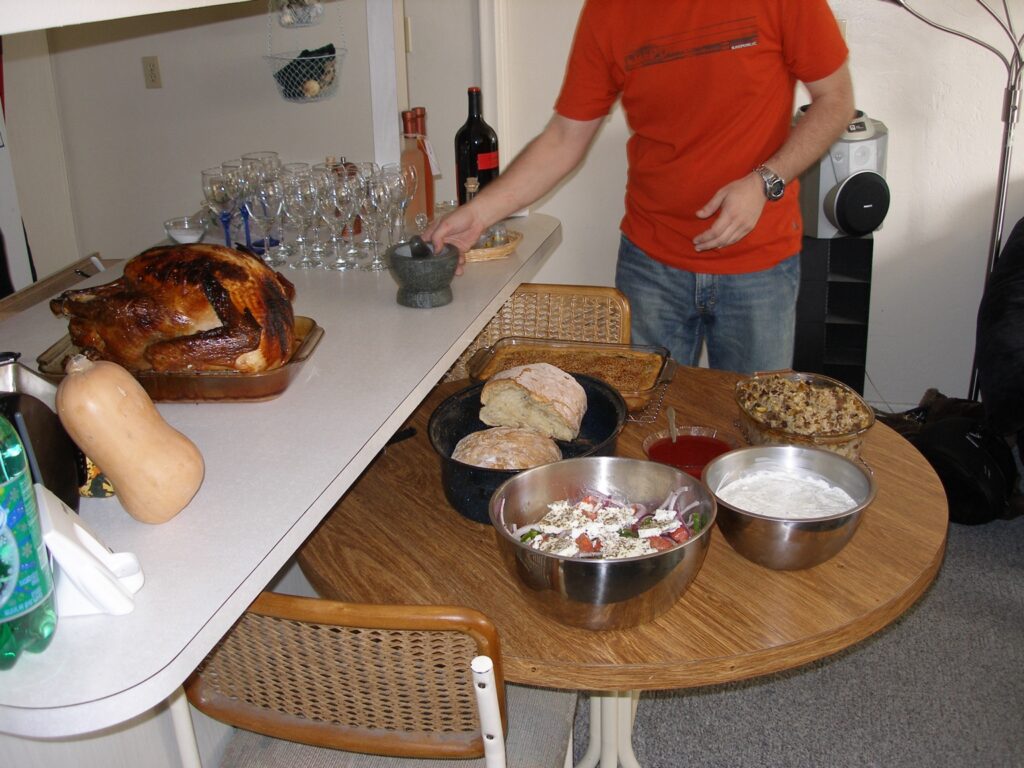
But something important was beginning to happen. We might not have felt American, and we certainly hadn’t grown up celebrating Thanksgiving, but we were starting to participate in the tradition. We were no longer simply watching Americans celebrate their holiday on television. We were making the food, gathering around the table, inviting friends, and creating our own memories. And although we didn’t necessarily realize it at the time, we were beginning to make Thanksgiving part of our own lives.
From 2005 through 2010, we would celebrate Thanksgiving at my house and then go to Deborah’s house as well. And every year, the celebration at my house seemed to get bigger and bigger. At some point, we had something like thirty people! Thirty people gathering for Thanksgiving, with all the food, preparations, excitement, and inevitable chaos that comes with trying to feed a crowd that size.
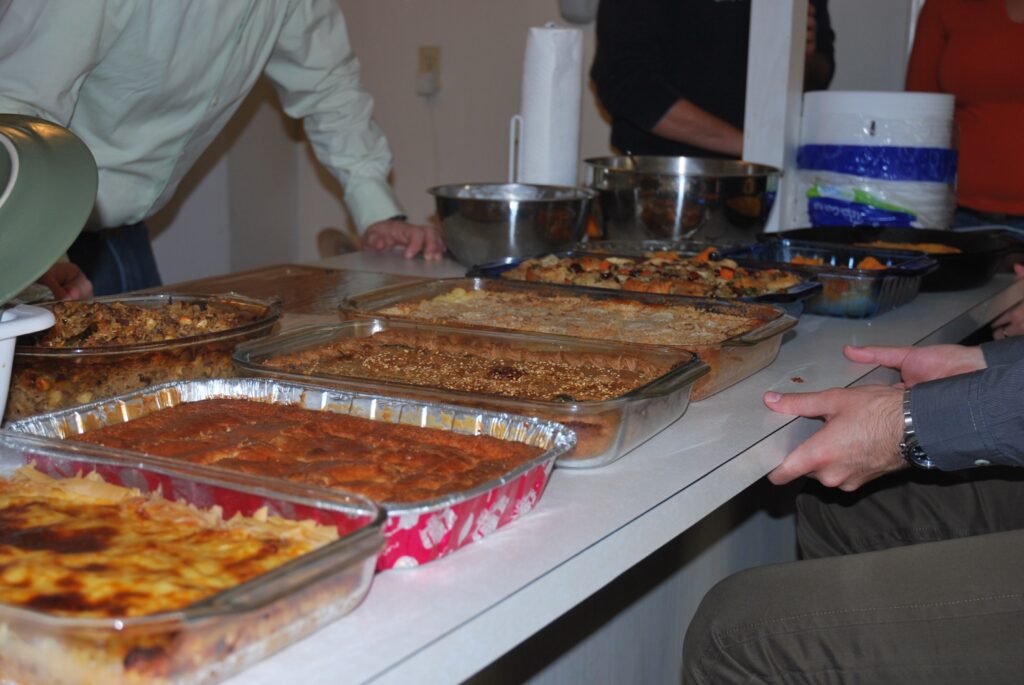
As the years went by, my Thanksgiving feast became quite an elaborate production. I would spend an enormous amount of time planning the menu, shopping, preparing ingredients, and cooking. The number of dishes kept growing, the preparations became more involved, and what had started as a simple attempt to make a turkey with mashed potatoes and stuffing eventually turned into a massive Thanksgiving dinner. I actually have an entire post called Thanksgiving Diaries, where I talk about everything I cooked and what went into preparing one of those feasts. And I loved it. I loved the cooking, the planning, the anticipation, and even the exhaustion that came afterward. There is something incredibly satisfying about spending so much time preparing a meal and then watching everyone gather around the table to enjoy it.
But looking back, as much as I enjoyed preparing all that food, the food itself was only part of what made those Thanksgivings so special. What really mattered was having all those people together, sharing a meal and enjoying each other’s company. We came from different backgrounds, different countries, and different cultures. We didn’t necessarily share the same childhood memories or family traditions, but we were creating new memories together. And somehow, over the years, Thanksgiving became something that belonged to all of us. It was no longer simply an American holiday that we happened to celebrate. It had become our tradition, something we looked forward to, something we planned for, and something that brought us together year after year.
I think back to Deborah Anderson and how she opened her home to so many international students, and I realize how important that simple gesture was. She made us feel welcome in a country that, for many of us, was still unfamiliar. She gave us the opportunity to experience something that we might otherwise have known only from television shows and movies. And eventually, without really planning it that way, I found myself doing the same thing. I was opening my own home, inviting friends, cooking an enormous amount of food, and creating memories that would stay with us long after we finished the last piece of turkey. What began as someone else’s tradition had gradually become my own.
What Makes Thanksgiving So Special
And I think this is where Thanksgiving becomes something truly extraordinary, particularly for immigrants. Thanksgiving doesn’t depend on who you are, where you were born, what language you speak, or what you believe. You don’t have to be American to appreciate it, and you certainly don’t need to have grown up celebrating it. The warmth of being surrounded by people you love, the comfort of sharing a meal with friends and family, the happiness of feeling welcome and appreciated—these are universal human experiences. They are not exclusively American feelings. They are feelings that people everywhere understand, regardless of their culture, religion, or background. And yet Thanksgiving brings all these things together in a way that is so deeply connected to American culture.
That is what makes this holiday such a wonderful introduction to America for someone who comes here from another country. You can be Greek, Italian, Chinese, Indian, or from anywhere else in the world. You can bring your own traditions, your own experiences, and your own understanding of family and friendship to the table. You don’t have to abandon any of those things to participate in Thanksgiving. You simply join in. You share the food, you enjoy the company, and you become part of a tradition that millions of other people across the country are celebrating at the same time. And through that simple act, you begin to feel connected to the country where you are living. You begin to feel that you are part of its culture, that you have a place in its society, and that your presence here means something.
And this brings me back to what Thanksgiving really means to me. I understand that many people love Thanksgiving because of the way it makes them feel. It is about family, friends, gratitude, and appreciating what you have. But as an immigrant, that feeling goes even deeper. Thanksgiving is the holiday that made America feel like home to me. I embrace the food and all the festivities associated with it, not simply because I love the food, which obviously I do, but because of the sense of belonging that comes with the celebration. You might be an immigrant, you might be an international student pursuing a degree, or you might be here temporarily for work. You might not even know whether you will be allowed to stay in the country permanently. But when you sit around a table and share that Thanksgiving meal, just as millions of other Americans are doing, you feel that you belong to this country. Celebrating Thanksgiving doesn’t suddenly make you a citizen or suddenly make you part of America. But it gives you the gratifying feeling that you belong to America, that America is made for you just as it is for millions of other people. And that feeling of belonging to a country you have the privilege of calling home—even if it’s home for only a little while—is something nothing else can top.
And I cannot emphasize enough how meaningful that feeling is. You might still have a visa with an expiration date. Your documentation might allow you to remain in the United States for only a limited time. Your role in this country might, at least legally, have an expiration date as well. But none of that changes what you feel at that moment. You are participating in the same traditions, sharing the same experiences, and celebrating the same holiday as everyone else. You are not simply observing American culture from the outside. You are part of it. Not necessarily as a citizen, not because of a passport or a legal document, but because you are living here, contributing to this country, and sharing in its traditions. You begin to believe that you have a role to play here, that your presence matters, and that you are an integral part of this country, even if your time here is temporary. For that one day you don’t become an American, but you feel you belong to this country. You celebrate love, friendships, family, and you feel that the country is made for you you just as every other American. For one day you feel that this is your home and you belong here. And nothing can top this feeling.
For someone who was born and raised in America, that sense of belonging might seem perfectly natural. It is something you have always known, something you might never have had a reason to question. But for someone who arrives from another country, it is not necessarily automatic. You can live somewhere, study there, work there, and build friendships, yet still feel that you are somehow a visitor. Thanksgiving has this remarkable ability to make that distinction disappear, even if only for a day. It allows you to participate in something that belongs to the entire country, while making you feel that the country belongs to you as well. Not in the sense of ownership or citizenship, but in the much more personal sense of belonging. In the times we live where undocumented immigrants have become the most contested issue of the country I know, that that day all these people will gather and share a meal with the people they love and for that one day they will feel the belong here as much as I do. They feel that this country is for them as much it is for me.
And I think that is what makes Thanksgiving unique. It is a holiday that allows people to come together without necessarily sharing the same history, religion, or cultural background. It is a celebration of something that we all understand: the desire to be surrounded by people we love, to feel welcome, and to appreciate the good things in our lives. There is something incredibly comforting about that. Something cozy, something familiar, something that reminds us of home, regardless of where home originally was. And I really appreciate the fact that we have an opportunity, every year, to experience that feeling and to share it with others.
A Holiday That Became Home
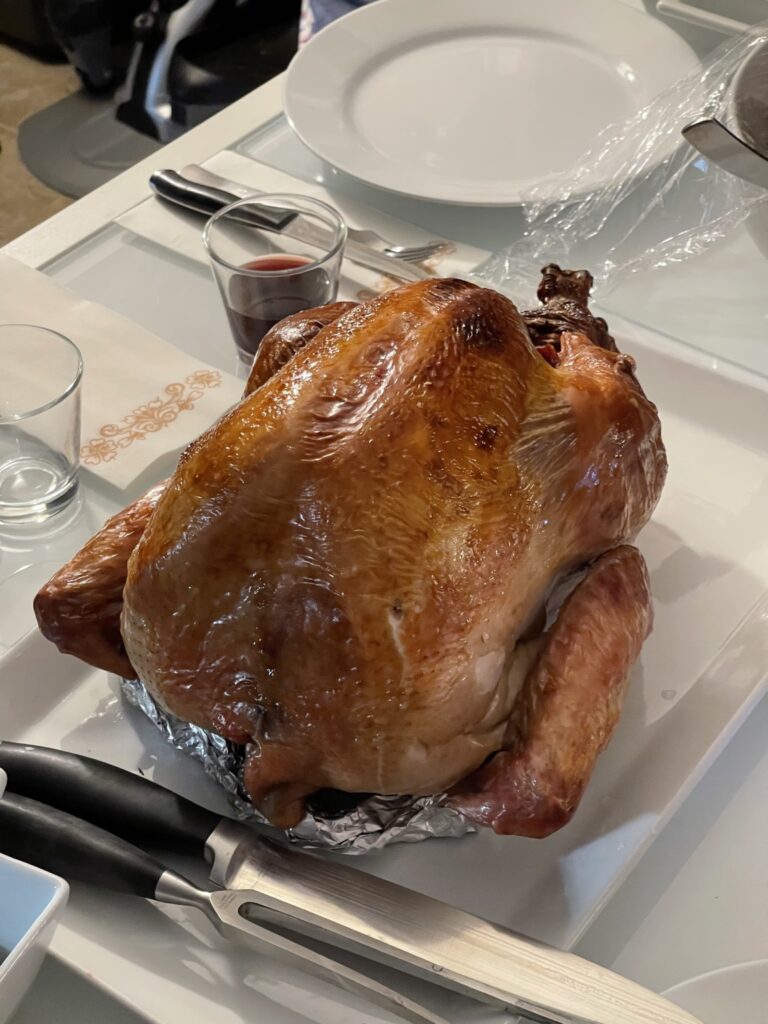
When I think about my first Thanksgiving in 2001, when it was nothing more than two days off and a twelve-dollar meal at a Chinese buffet, I cannot help but smile. I had no idea then how important this holiday would eventually become to me. I didn’t know that a television episode about cooking a turkey would inspire me to prepare my own Thanksgiving dinner, or that the generosity of someone like Deborah Anderson would help me understand what the holiday was really about. I certainly didn’t know that, a few years later, I would be hosting Thanksgiving dinners for thirty people and looking forward to the celebration more than almost any other holiday.
But that is exactly what happened. Somewhere along the way, Thanksgiving stopped being an American holiday that I happened to observe and became a tradition that I genuinely felt was mine. It became part of my life, part of my memories, and part of my connection to this country. And the wonderful thing is that embracing Thanksgiving never required me to stop being Greek or to forget where I came from. It simply allowed me to become part of something new, to add another tradition to my life, and to feel that the country where I had come to study had become something much more than a temporary place to live.
I think that is one of the most beautiful things about being an immigrant. You don’t necessarily have to choose between the culture you came from and the culture of the country where you now live. You can carry both with you. You can cherish the traditions of your childhood while embracing new ones, and in doing so, you create something that is uniquely yours. For me, Thanksgiving became one of those traditions. It became an opportunity to celebrate the people around me, to share my love of cooking, and to feel connected to a country that had given me so many experiences and opportunities.
And no matter what I do in the future, no matter where life takes me, and no matter what happens along the way, I will always cherish the memory of the first time I truly felt that I belonged in America. That feeling, more than the turkey, the stuffing, the mashed potatoes, or even the cranberry sauce that I eventually learned to appreciate, is what makes Thanksgiving so special to me.
Thanksgiving is not simply a holiday I learned to celebrate after moving to America. It is the holiday that helped make America my home.