
I am not a reader of Vogue magazine. In fact, for a long time, I only knew Vogue as a fashion magazine. It was in the early 2000s, when Food Network brought Iron Chef to American television, that I first saw Jeffrey Steingarten, who became one of my favorite food critics.
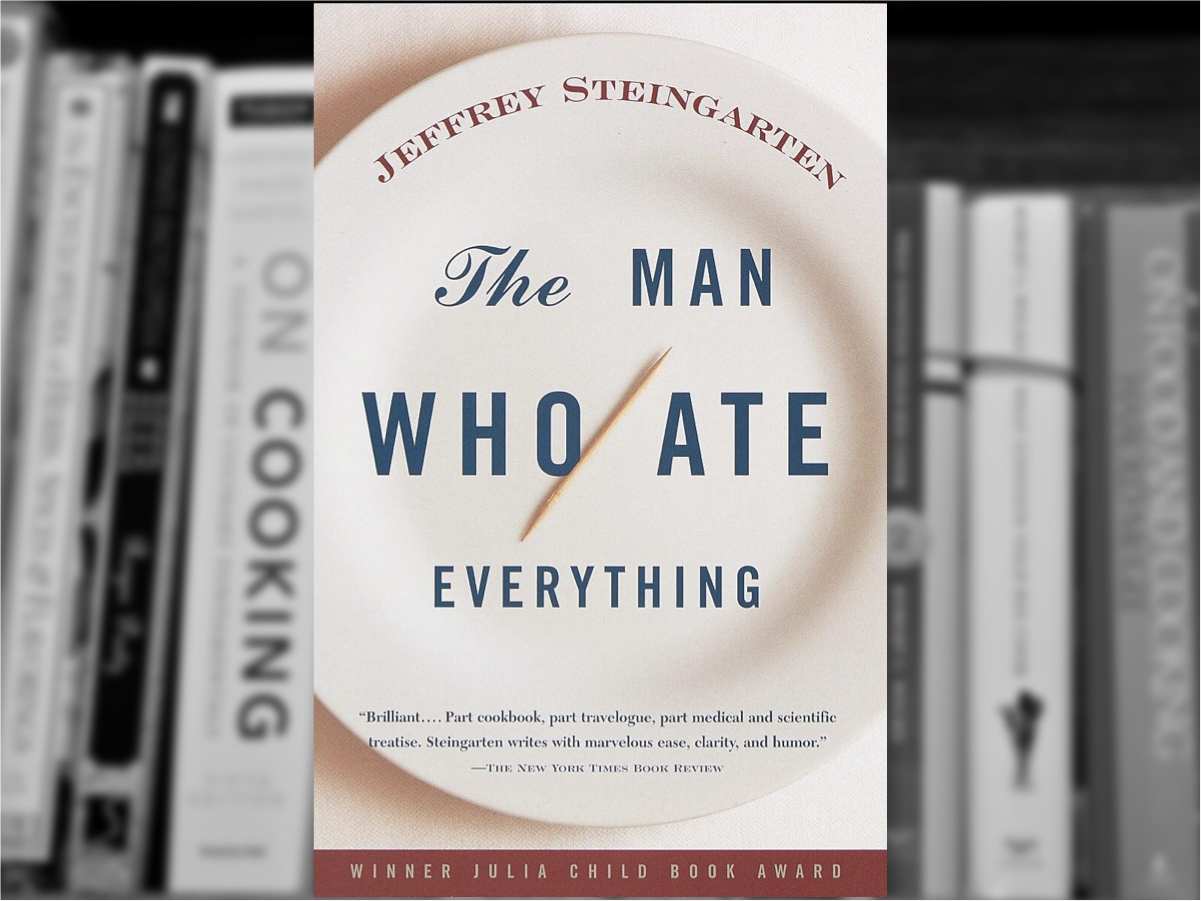
What impressed me was how well he described the food he was eating. His descriptions were so good that sometimes I felt as though I was actually tasting the food along with him. That was when I first became familiar with who Jeffrey Steingarten was and what he was doing. Soon afterward, I got his book, The Man Who Ate Everything, and it was a book that left a lasting impression on me.
I think that anyone who wants to become a food reviewer, whether online or in any other medium, and wants to do so with some sort of credibility, should read this book. There is a lot to learn from it. And that is why, almost thirty years after it was first published, I am writing a review of The Man Who Ate Everything. Because I think it is very important for people to know and understand Jeffrey Steingarten’s work.
Forgiving Jeffrey Steingarten for His Opinion of Greek Food
There is one more thing I have to mention. This book is so good that I am even willing to overlook the fact that Jeffrey Steingarten talks really badly about Greek food. At one point, he essentially suggests that Greeks should stick to philosophy and mathematics, where we are good, and that you shouldn’t expect much culinary adventure from a country that brines its cheese and puts resin in its wine. Now, to be fair, both of those things are true. We do brine our cheese, and we do put resin in our wine.
But I think his criticism needs to be understood in the context of when these essays were written, mostly during the mid-1990s. Back then, the unfortunate reality was that Greek food in the United States was not particularly well represented. Finding good, authentic Greek ingredients was difficult. You often had to rely on domestically produced feta, which, in my opinion, was not a particularly good cheese and certainly did not represent what real Greek feta should taste like.
The situation with wine was not much better. Greek wines had to be inexpensive enough to remain affordable after the cost of transporting them from Greece to the United States. As a result, much of what was available was cheap wine that hardly represented the quality and diversity of Greek winemaking. One of those wines was retsina, the traditional Greek wine flavored with pine resin.
So, while I understand where Steingarten’s impression might have come from, I think he was judging Greek cuisine based on what was available in the American market at the time, rather than experiencing Greek food at its best. And perhaps that is one of the greatest compliments I can give this book: as a Greek who loves his country’s cuisine, I can forgive Jeffrey Steingarten for dismissing Greek food so harshly. That’s how much I appreciate his writing.
A Book That Teaches You How to Think About Food
The Man Who Ate Everything was first published in 1997, and nearly thirty years later, some of the information presented in the book is undoubtedly outdated. This is particularly true when Steingarten discusses diets, nutrition, and the effects of certain foods on human health.
For example, some of his arguments about salt and its relationship with blood pressure were quite convincing at the time. But our understanding of the effects of sodium and potassium on blood pressure has evolved considerably. Today, we have a much better understanding of these relationships, and some of the conclusions presented in the book need to be reconsidered in light of more recent scientific evidence.
This raises an obvious question. If some of the information is outdated, why do I still consider this book so important? Why would I recommend it as a reference for anyone who wants to write or talk about food? The answer is simple. The value of this book is not that everything Steingarten wrote should be accepted as an unquestionable truth. Its value lies in the way he approaches food, investigates his questions, and communicates his findings.
Steingarten does not simply repeat something because he has heard it somewhere, nor does he automatically accept conventional wisdom. He questions it. And more importantly, he goes through the trouble of investigating it. I want to make an important distinction here. When I say investigate, I do not mean the modern version of “do your own research,” where everyone spends a few minutes searching the internet and suddenly considers themselves an expert. I mean actually learning about a subject. Asking questions. Finding the people who understand it better than you do. Looking for evidence and evaluating that evidence critically.
Steingarten was in a position where he could contact leading scientists, researchers, and people in the regulatory world to get information directly from those who understood the subject. And he took advantage of that opportunity. That, to me, is one of the things that makes his work stand apart.
Curiosity, Experimentation, and Scientific Rigor
One of the best examples of Steingarten’s approach is his investigation of French fries. He does not simply tell the reader that he likes French fries, or that McDonald’s makes the best ones, and expect everyone to accept his opinion. Instead, he goes through the trouble of visiting different places, comparing different samples, investigating preparation methods, and trying to understand what makes one French fry better than another. His conclusions are not based solely on personal preference. They are supported by a process of observation, comparison, and experimentation.
He applies a similar approach when investigating different diets. Rather than simply following a diet and announcing that he feels better or that it worked for him, he also looks for measurable evidence, including blood tests, to evaluate what is happening. Of course, this does not mean that every experiment he performs is scientifically conclusive. Personal experimentation has limitations, and individual results cannot necessarily be generalized to everyone.
But what I admire is his willingness to go beyond personal impressions and look for something more substantial. He understands that having an opinion is easy. Supporting that opinion with evidence requires considerably more effort. And this is something I believe every aspiring food critic should learn.
The Third Ingredient: An Extraordinary Palate
But I don’t want to give the impression that Jeffrey Steingarten’s greatness lies only in his writing style or the rigor of his investigations. That would be doing him a disservice. I think being a good writer and a good researcher represents only two parts of the equation. The third, and equally important part, is having a genuinely talented and investigative palate. And Steingarten certainly has that.
He has an extraordinary ability to judge food, recognize subtle differences, and identify the characteristics that make something exceptional or disappointing. This is not simply a matter of liking or disliking something. Everyone can do that. Being able to taste something, recognize its individual qualities, understand why it works or why it fails, and then communicate that experience to someone who has never tasted it requires a completely different level of talent.
Steingarten combines that ability with an almost obsessive curiosity and a willingness to try practically everything. And I think that combination is incredibly rare.
The Olestra Experiments
His encounters with Olestra are another perfect example of his unusual approach to food. Olestra was a fat substitute that attracted considerable attention and controversy because it was designed to provide some of the characteristics of fat without being absorbed by the body in the same way. Rather than simply accepting what people were saying about it, Steingarten decided to investigate the subject himself.
He describes his encounters and experiments with remarkable precision, going into extraordinary detail about what he did, what he observed, and what he learned. What fascinates me is not simply the subject of Olestra itself, but the lengths to which he was willing to go to satisfy his curiosity. I honestly cannot imagine many food writers going through that much trouble.
And yet, for Steingarten, this kind of investigation seems almost natural. He wants to understand something, so he investigates it. He wants to evaluate a claim, so he tests it. And then he takes the time to describe the entire experience in a way that is both informative and entertaining. That is a rather unique approach to food criticism.
The Art of Writing About Food
Of course, none of this would be nearly as enjoyable if Steingarten were not such an extraordinary writer. His writing style is incredibly engaging. He can take a subject that might otherwise seem technical, complicated, or even boring and turn it into something genuinely entertaining. He combines scientific curiosity with humor, personal experiences, and a remarkable ability to describe food. And he does all of this without sacrificing the depth of his investigations.
There are very few food writers whose work I admire as much as Jeffrey Steingarten’s. Anthony Bourdain is another one who immediately comes to mind. Although their approaches are quite different, both have an extraordinary way with words. They can make food interesting beyond the simple question of whether something tastes good or bad. They can communicate experiences, observations, and opinions in a way that makes the reader feel involved.
And that is a talent that cannot be replaced by simply having good taste or knowing a lot about food. It is the ability to translate an experience into words. In Steingarten’s case, that ability is so remarkable that sometimes you can almost taste the food he is describing.
Why This Book Still Matters
Nearly thirty years after its publication, some of the ideas presented in The Man Who Ate Everything are undoubtedly outdated. Our understanding of nutrition, diet, and the effects of certain foods on human health has evolved considerably. But that does not diminish the importance of this book.
I still consider it essential reading for anyone aspiring to become a food reviewer, food critic, or food writer, assuming food writing is still a thing. These days, everyone seems to be moving toward Instagram and TikTok, where quick impressions, short videos, and instant gratification have largely replaced thoughtful, detailed food criticism. But perhaps that makes this book even more important today.
Whether you are writing a lengthy restaurant review or making a thirty-second TikTok video, there is something to learn from Steingarten. His writing is thorough, extraordinarily descriptive, and so engaging that he rarely leaves you with unanswered questions. More importantly, he demonstrates that food criticism should be more than simply announcing whether you like something. It requires curiosity, knowledge, investigation, judgment, and the ability to communicate an experience in a meaningful way.
And that is why I believe The Man Who Ate Everything should be required reading for anyone who wants to express opinions about food with some degree of credibility. Because even if some of the scientific conclusions have changed, the principles behind Steingarten’s approach remain just as valuable today.
And perhaps the most remarkable thing about this book is that, almost thirty years later, his descriptions are still so vivid that occasionally you can actually taste what he was eating. That, to me, is the mark of a truly exceptional food writer. And that is why The Man Who Ate Everything deserves a permanent place on my bookshelf.