The discovery
I arrived in the United States in August 2001, carrying my dreams, my ambitions, and probably more luggage than I needed. I had come here to study, and like any graduate student, I had to make some important decisions about my new life. Where would I live? What would I eat? And, perhaps most importantly, could I survive without a television? The answer to that last question was approximately one month. I tried. I really did. But eventually, I gave in, bought myself a small TV, and signed up for cable. Little did I know that this seemingly insignificant purchase would change my life.
One of the first things that absolutely fascinated me about America was that there was an entire television channel devoted exclusively to food. An entire channel! The Food Network. Coming from Greece, where cooking was certainly an important part of everyday life, I found the concept extraordinary. Twenty-four hours of people cooking, talking about cooking, eating, and discussing food. What a country!
And apparently, there was also something called the Cooking Channel. But that’s another story. Naturally, I became a devoted Food Network viewer. Now, being a graduate student meant spending most of my days at the university. I would typically return home around six or seven in the evening, exhausted from a day of experiments, studying, and whatever else graduate school decided to throw at me. And what better way to relax than watching someone else cook? One of my absolute favorite shows was Emeril Live, hosted by Emeril Lagasse. BAM! If you know, you know.
I loved that show. Actually, I still consider it one of my favorite cooking shows of all time. Emeril’s energy, his enthusiasm, the live audience, and his obvious love for food made the whole experience entertaining. Cooking wasn’t simply about following instructions. It was a performance, a celebration. I would often wait for Emeril Live to begin in the evening. It was practically prime-time television for food enthusiasts. But one evening, sometime around 2002, while waiting for Emeril, I stumbled upon another show. It was called Good Eats. And it was… weird. I remember the scene surprisingly well.
There was a turkey in an oven. Nothing particularly unusual about that, right? Except that someone had placed a little velvet curtain in front of the oven, almost like a theatrical barrier, to prevent people from approaching it. A velvet curtain. In front of an oven. Who does that? What kind of cooking show was this? Naturally, I kept watching. The host was a rather peculiar fellow named Alton Brown. Instead of simply showing viewers how to cook a turkey, he was explaining what was actually happening inside it. The physics. The chemistry. The heat transfer.
Wait a minute. Physics? Chemistry? On a cooking show? Now, that got my attention. You see, my academic background was in materials science and engineering. I spent my days studying how materials behave, how their structures influence their properties, and how they respond to different conditions. And suddenly, here was someone explaining that cooking wasn’t all that different. Food, after all, is made of materials. Proteins, carbohydrates, fats, water, and countless other compounds. They all have structures, properties, and behaviors. Apply heat, introduce moisture, change the pH, or modify the composition, and those materials transform.
Sound familiar? That’s materials science! The more I watched Good Eats, the more I realized that the scientific principles I was studying and applying in my professional life could also explain what was happening in my kitchen. Why does meat brown? Why does bread rise? Why do some sauces separate while others remain perfectly smooth? Why does changing the temperature by just a few degrees sometimes make an enormous difference? Suddenly, cooking became something more than following recipes. It became an experiment. And unlike some of my experiments at the university, these experiments were usually edible.
Usually. I became fascinated with the idea that understanding the science behind cooking could make me a better cook. Instead of simply knowing what to do, I could begin to understand why I was doing it. And once you understand why something works, you can start experimenting. You can modify recipes, improve techniques, and occasionally invent something entirely new. Alton Brown had managed to connect two things I already loved: science and food. And without realizing it at the time, that strange television show with the turkey and the velvet curtain had planted a seed.
A seed that would eventually grow into something much bigger. Of course, nothing happened overnight. For the next several years, I continued studying, experimenting, cooking, and watching Good Eats whenever I had the opportunity. Meanwhile, something rather amusing was happening among my friends. They started calling me Chef. Now, let me make something perfectly clear. I was not a chef. I had never attended culinary school. I had never worked in a professional kitchen. And I certainly didn’t have the training, experience, or endurance required to run one. Being a professional chef is an incredibly demanding occupation, and I have tremendous respect for the people who dedicate their lives to it.
I was simply a guy who loved to cook. But apparently, when you’re the person among your friends who gets unusually excited about spices, cooking techniques, and the chemistry of dinner, you eventually earn a nickname. Chef. And somehow, it stuck. What I didn’t know yet was that this nickname, my fascination with food science, and my growing desire to share what I was learning would eventually come together. But that part of the story would take another four years.
A Chef’s Blog — Where It All Began
Over the next four years, something interesting happened. The more I cooked, the more I learned. And the more I learned, the more I realized just how much science was hiding in everyday cooking. I was beginning to understand food in a completely different way. What started as a fascination with a quirky television show had become something of an obsession. A delicious obsession, admittedly. But there was a problem. I wanted to share what I was learning. Now, remember, this was the early 2000s. Social media as we know it today didn’t really exist. There was no Instagram, no TikTok, and certainly no endless stream of people filming themselves making dinner.
Instead, we had something called blogs. For younger readers who have never encountered one, imagine TikTok—but instead of recording a short video, you sat down and actually wrote something, and instead of watching it, people had to read it. Yes, read! You shared stories, recipes, photographs, and whatever else you wanted to tell the world. People could subscribe to your blog, follow your updates, and return whenever you published a new post. It was essentially social media before we called it social media, only with considerably more typing and far fewer dance routines. Blogs were becoming increasingly popular, and suddenly anyone with an internet connection and something to say could have their own little corner of the web. And apparently, I had quite a lot to say.
Mostly about food. So, in June 2006, I started my first food blog on Blogger. I called it A Chef’s Blog. Why that name? Well, remember how my friends had started calling me Chef? Exactly. It seemed like the obvious choice. Now, before anyone gets the wrong impression, let me repeat something. I was not a chef. I had never been a professional chef, and I certainly wasn’t claiming to be one. I was a materials scientist who happened to be fascinated by cooking. Would I have liked to become a chef? Actually, yes. There was certainly a part of me that found the idea incredibly appealing.
But that’s a different story, and perhaps one for another day. For now, I had something else. A blog. A place where I could combine my love of cooking, my scientific curiosity, and my tendency to get unnecessarily excited about the smallest culinary discoveries. And so, A Chef’s Blog was born.
Recipes, experiments, and a few mistakes
I started writing about my experiences, sharing recipes, and trying to back up what I said with science. Always science. Was every scientific explanation correct? Absolutely not. Looking back, I can recognize that some of the facts I shared were wrong. But the intention was genuine: I wanted to understand food and explain what was happening, not just tell people what to put in a pan. Over time, I published several recipes and articles on that little Blogspot site. Each post was another chance to experiment, learn something, and share the results with anyone who cared to read them.
And that was how the journey began.
From Blogger to Apple
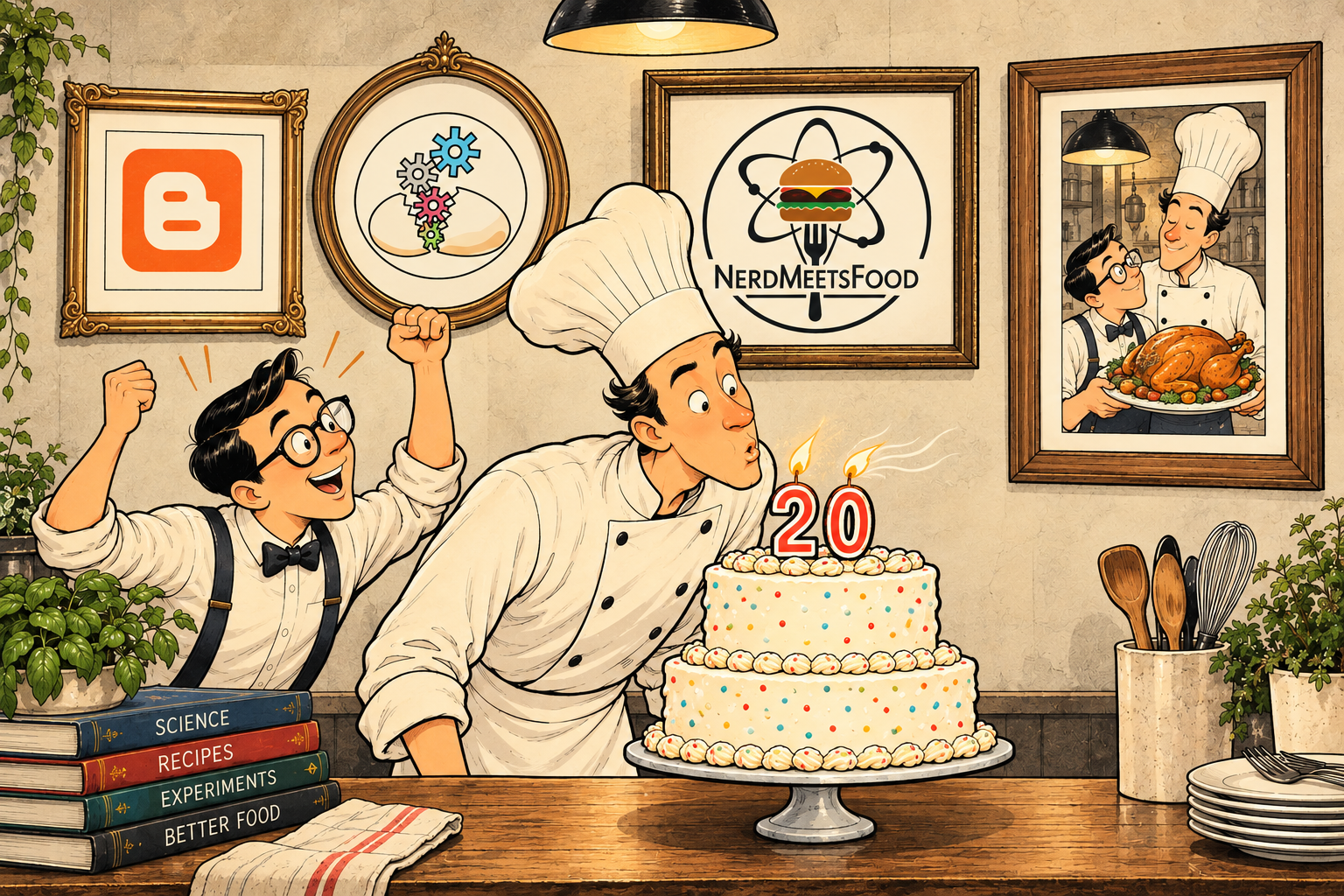
Soon enough, I started thinking that A Chef’s Blog deserved a home of its own. Now, don’t get me wrong—there was absolutely nothing wrong with Blogger. It had given me a place to start, and for that I was grateful. But I wanted something a little more personal. Something that felt more like my own website. At the time, Apple offered web services that eventually became known as MobileMe. I moved my food writing to Apple’s hosting platform and continued publishing recipes, experiments, and whatever culinary curiosity had captured my attention that week. A number of the older articles you can still find on NerdMeetsFood today, including posts dating back to 2008, come from that period. Different platform, same enthusiastic guy trying to explain dinner with science.
But moving my writing was only half the challenge. I also wanted a better way to build and manage the actual website. I wanted it to look and feel the way I imagined it, without having to wrestle with every little detail. Now, WordPress had already been around since 2003. But at the time, I didn’t know much about it. Instead, I came across a nifty piece of Mac software called RapidWeaver. And here’s something you should know about being a student: you look for free software. Always. Unless you really, really need something. RapidWeaver was one of the few applications I actually paid for, alongside a handful of scientific software packages. But that’s another story.
RapidWeaver turned out to be exactly what I needed. It gave me the freedom to shape the site the way I wanted, organize my writing, and build something that felt less like a standard blog template and more like my own little home on the internet. I could have sections for my recipes, my articles, and the food science that kept me fascinated. The content was still the same mixture of experiments, explanations, and occasional culinary misadventures. But now I had much more control over how I presented it. For a few years, that arrangement worked beautifully. Then Apple decided to discontinue its web-hosting service.
Giving the Blog Its Own Identity
Moving the blog to MobileMe and rebuilding it with RapidWeaver was more than just a change of platform. Until then, the blog had been part of my personal website, sharing space with all my other interests. Now, for the first time, it had a home of its own. And I figured that if it was going to stand on its own two feet, it deserved a logo.
Around that time, I was also considering a different name for the site. Two possibilities I played with were Food Engineering and Cook Engineering. I liked the idea of combining food with science and engineering, and I wanted the logo to reflect that.
That’s how the egg and gears came about.
I thought an egg would be the perfect food item to build the design around. It’s simple, instantly recognizable, and fundamental to cooking. But this wasn’t going to be an ordinary egg. In my version, the shell was cracking open at the top, with colorful gears bursting out of it. It was a playful way of bringing together two things I loved: cooking and engineering.
That became the blog’s first logo, and it stayed with us for many years.
Interestingly, sometime after I had created it and started using it, I discovered another food blog, Ideas in Food, that had a surprisingly similar concept for its logo. Their design also featured a cracked egg, except theirs was cracking downward, with a lightbulb falling out of it. Mine cracked upward, with gears flying out. The resemblance was entirely unintentional, but it always stayed in the back of my mind.
The original egg and gears will always have a special place in the history of NerdMeetsFood. It was the first time I tried to give the blog a visual identity of its own, and it represented exactly what I wanted the site to be: a place where food, science, and a little bit of engineering could come together.
And just like that, my little corner of the internet needed a new home. This time, I realized, perhaps I should find a more permanent place for it.
A New Home: WordPress and NerdMeetsFood
When Apple discontinued its web-hosting service, I was faced with another move. I had spent years building the site and collecting recipes and stories, and I wasn’t about to let them disappear because a company had decided to pull the plug. This time, I wanted my own domain, my own hosting, and a platform that wouldn’t tie the future of my writing to one particular piece of software.
That’s when WordPress finally entered the picture. It had actually been around since 2003, but I hadn’t known much about it during my Blogger and RapidWeaver days. Moving to WordPress was not quite as simple as packing a suitcase and changing addresses. Transferring all those pages, recipes, and images from the old system took work, and I suspect a few things never made the journey in quite the form I intended. But it gave the blog a new foundation, one that could grow and change without forcing me to rebuild everything from scratch.
By then, I was also ready for a name that better reflected what I was trying to do. I wasn’t really writing a chef’s diary. I was a scientist who loved food and wanted to understand it. And so, A Chef’s Blog eventually became NerdMeetsFood. I think the name says it all: a nerd, meeting food, and asking far too many questions about what happens in between.
Over the years, the website has changed its appearance, its software, and even the way I organize my recipes and articles. There have been periods when I wrote frequently and others when life got busy and the blog was quiet. But the curiosity that started it all—the desire to understand food and share what I learned—never really went away.
When I recently decided to give NerdMeetsFood a fresh, modern look, redesigning the logo was part of that process. I wanted something new, something cleaner, and something that reflected what the site had become after twenty years. And, admittedly, I was also happy to finally move away from a design that had turned out to be so similar to someone else’s.
From Blog Posts to Viral Recipes
The internet, of course, kept changing. The world that had once revolved around blogs gradually moved toward social media, and eventually platforms like TikTok made it possible for a recipe to reach millions of people in a matter of days. The funny thing is that the format had changed completely, but the curiosity behind it was often the same. People still wanted to discover something new, try it in their own kitchens, and share the results.
At some point, I started bringing some of those viral TikTok recipes to NerdMeetsFood as well. It was a fun way to connect a blog that began in 2006 with the way people discover food today. I could try the recipes, share my experiences, and bring the same curiosity that had inspired A Chef’s Blog in the first place. The platform might have changed from written posts to short videos, but for me the interesting question remained: What makes a recipe work, and is it actually worth making?
In a way, it brought the story full circle. Nearly twenty years after I had started writing about food on Blogger, I was still discovering recipes on the internet and bringing them back to my own little corner of it. Only now, instead of finding inspiration on a television channel, I could find it on a phone screen.
More Than a Recipe Collection
Looking back now, twenty years after I started A Chef’s Blog, I realize that NerdMeetsFood has become something much more personal than I ever imagined. Yes, it contains recipes, cooking experiments, and explanations of food science. Some of those explanations are better than others, and I would certainly write a few of them differently today. But every article captures a little piece of who I was when I wrote it. Somewhere along the way, though, life happened. I got married. I had kids. And whatever free time I had, I wanted to spend with them. Every so often I would promise myself that I would start writing regularly again. And every time, life had other plans.
I used to think that the solution was simply to get back on the horse and make another promise. But perhaps that is the wrong way to look at it. Writing isn’t an obligation I need to keep failing at. It is a desire. Sometimes I follow it, sometimes I don’t, and that’s okay. Things change. They always have, and they always will. My last true recipe post was the cold foam in 2019—a year before COVID, and a year before my daughter was born. Do I regret not posting regularly after that? Not for a second. Every minute was worth it. This blog was my first brainchild, but having actual children has a remarkable way of changing your perspective.
Nonetheless, I eventually jumped into TikTok. And I have to admit, recording a video, editing it, and adding a voice-over often felt much simpler than sitting down to write a full blog post. A few of the recipes that became most popular there also found their way back to NerdMeetsFood: my chili con carne (yes, another little nod to Alton Brown) and my lemon chicken. That lemon chicken, in particular, is more than a recipe to me. It is a meal I ate countless times under the hot Cretan summer sun, sitting in the shade of an old olive tree. I still eat it, by the way—only now I’m at home in New Jersey, enjoying the comfort of my air conditioning. Sweating while eating was part of the experience, but I think I’ve loved that part quite enough!
And that is exactly why this blog matters so much to me. It is my home on the internet, my cooking album. I may share fewer recipes going forward, but perhaps I will share more stories. Because when I look through these pages, I don’t just see dishes. I see my mom’s cheese pie and pizza recipes. I see my grandmother’s cured olives and the genuine hospitality that came with them. I see the cocktail I made for my then-girlfriend, who is now my wife; another cocktail made for a friend’s wedding; and a tempeh cake I made for a friend. Every one of them has a person, a place, and a memory behind it.
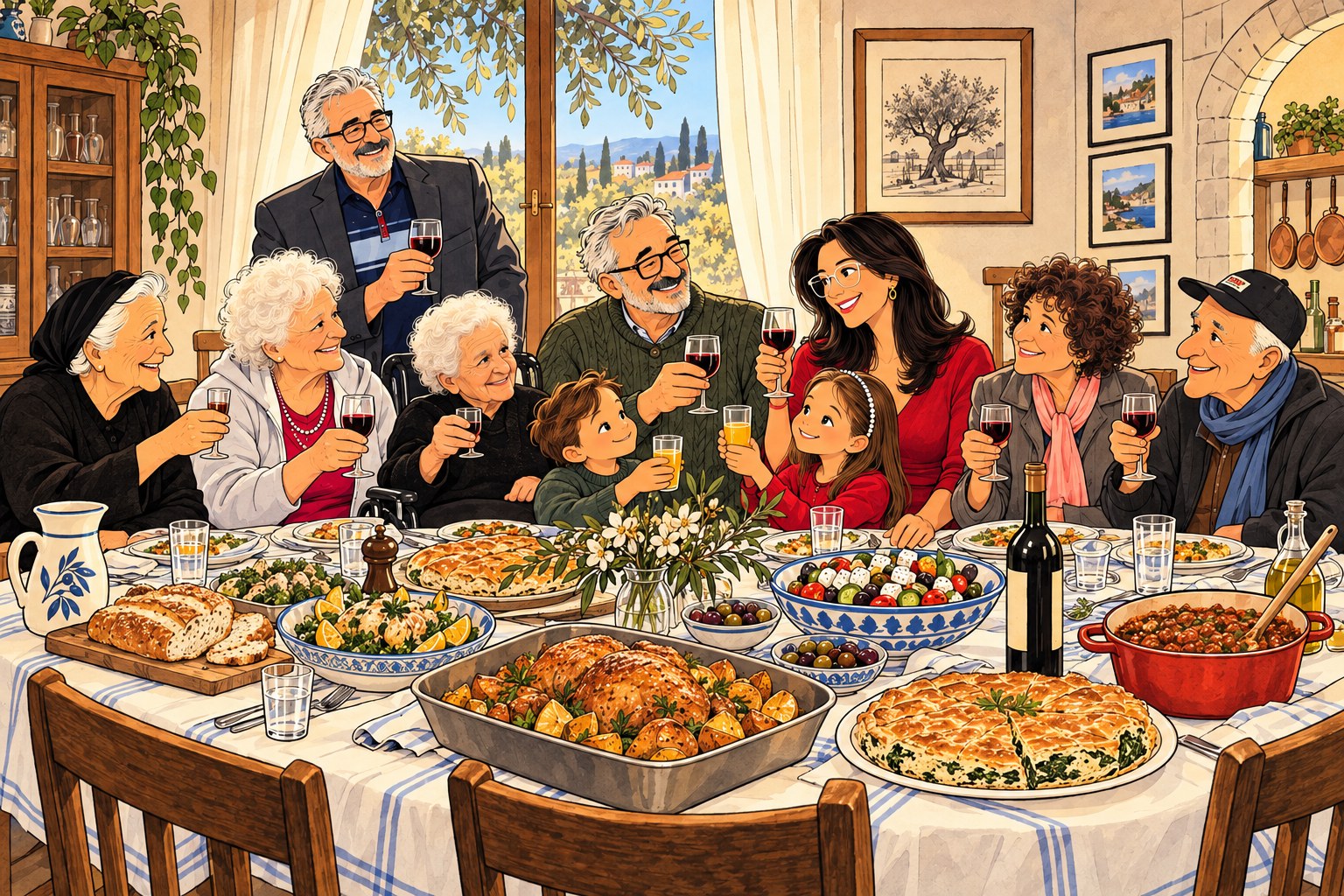
A recipe is never just a list of ingredients and instructions. Sometimes it is the smell of a kitchen, the sound of a familiar voice, the heat of a summer afternoon in Crete, or a moment shared with someone you love. This blog is where those things live together. It has followed me from graduate school to marriage and fatherhood, from Florida to New Jersey, from Blogger to MobileMe to WordPress, and from writing long posts to making short videos. The format may have changed, but the reason I keep coming back has not.
So this isn’t another promise that I will publish every week, or every month, or even every year. I would like to write more, of course. I always would. But what matters more is keeping this little corner of the internet alive, so the stories are here whenever I have another one to tell. Even if I never publish another recipe, I would still want NerdMeetsFood to exist. Because it isn’t just a cooking blog anymore. It is a personal archive of food, science, family, friendships, Greek roots, and twenty years of memories.
Hopefully, this website will still be here twenty years from now—even if I don’t publish another single recipe. And hopefully, the web will still be here too.
Have the best of times cooking, learning, and eating.